

Thalictrum dioicum
Early Meadow Rue is a graceful spring-blooming perennial with long-stalked leaves divided into many delicate, lobed segments. This plant is dioecious, with separate male and female flower. Petal-less male flowers have yellow stamens that hang like small tassels. The female tassel-like blossoms are purple and appear on separate plants. Found in…
Scutellaria lateriflora
A perennial plant in the mint family with toothed, opposite leaves and a square stem. Small, trumpet-shaped flowers, varying in color from pale blue to lavender or even white over most of the summer. It is easily identified by the small size of its flowers, usually found in pairs or single.…
Iris virginica
This is the most common tall iris in the state, reaching up to three feet, and is usually the species one thinks of when picturing an iris. A lovely, delicate native found typically in wet areas. Clumps of bright green, somewhat droopy, sword-like leaves are topped with light blue to violet…
Sassafras albidum
This is an easily identified small to occasionally medium deciduous tree, growing at times to 50 feet high, but usually smaller. It can be found in old fields, fencerows, mesic to upland woods, and forests of many types. It is somewhat of a pioneer woody species, frequently growing in dense stands…
Solidago speciosa
It’s no mystery why this species is called Showy Goldenrod! From its impressive height paired with its densely clustered vibrant yellow flowers, a stand of this species in bloom is a quite spectacular sight. The upright stems host foot-long rods of golden yellow flowers in the early fall followed by wispy…
Scrophularia lanceolata
Puzzlingly very rare in North Carolina, certainly under-observed or mistaken for the more common species Scrophularia marilandica. Found in only a handful of counties, this upright perennial frequents upland hardwood forests with slightly acidic soils. Not known for their beauty—blooms could be called subtle—but they are abundant in nectar! This makes…
Salvia lyrata
Recorded in all 100 NC counties, this long-lived perennial is one of the most common across the entire state! Despite its prevalence, no other species resembles this one, in leaf or flower, and it can be seen daily, often many times a day. Each basal leaf is lobed like a lyre,…
Rudbeckia triloba
Brown-eyed Susan is easily identified by its unique brown center cone and the many dozens of showy golden-yellow flowers that appear in early summer. It is an herbaceous biennial or short-lived perennial that grows in a wide range of environments. Fairly common in most of the North Carolina mountains and thriving…
Rhexia virginica
In its natural setting, Meadow Beauty can be found growing in wetlands, wet meadows, and open sandy locations. It stands between 1 to 1.5 feet tall. The taller plants sprawl along the ground while shorter ones stand erect. Growing from an underground tuber, it is known to spread rapidly which makes…
Parthenium integrifolium
Rare and unusual, this is a gorgeous native plant with everything one could want in a garden perennial: upright form, excellent foliage, a long bloom time, and resistance to insects and disease. Typically found in the openings of oak-hickory woodlands, clearings, powerlines, and roadsides, it adapts well to disturbance, heat, and…
Verbena hastata
Thriving in wet prairies and open meadows, Blue Vervain is a biennial that can tolerate part shade but does best in full sun and wet conditions. Upright stems of this plant can grow up to five feet, but pinching off tops of plants before they bloom can encourage them to grow…
Stachys tenuifolia
Smooth Hedge-nettle is a showy, erect perennial in the mint family. Pink and white flowers bloom in a whorled formation during summer, attracting long-tongued bees. With ideal conditions they can get up to three feet tall but are often shorter. They are gorgeous in mass and would fit perfectly in a…
Heliopsis helianthoides
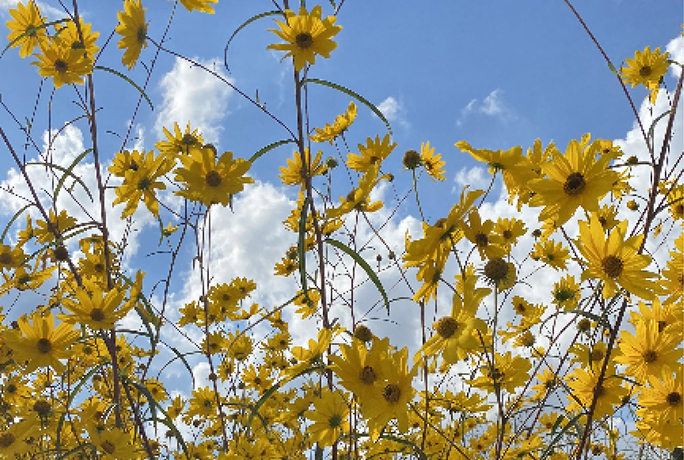
Resembling the common sunflower, this showy wildflower has smaller flowers with more abundant blooms. Oxeye Sunflower shows off its bright yellow daisy-like flowers between May and October, providing visual interest over a long bloom period and are great as cut flowers. With its easygoing nature, it makes a great addition to…
Helenium autumnale
Common Sneezeweed is a showy upright perennial in the sunflower family. Bright yellow disc flowers have 3-toothed petals that droop away from round yellow centers in late summer and early fall. They are a fantastic pollinator plant and are frequently visited by native bees. As petals fall away and seeds mature,…
Gillenia stipulata (Porteranthus stipulatus)
American Ipecac is an herbaceous perennial or subshrub in the rose family. This deciduous plant has alternately arranged and trifoliate-pinnatifid leaves, with dentate margins. In fall, leaves turn yellow to red. In early summer, delicate white star-shaped flowers with four to five petals appear. Although these flowers aren’t super striking, they…
Eupatorium rotundifolium
Roundleaf Thoroughwort is known for its umbels filled with clusters of white flowers, frequently visited by flying insects including wasps, butterflies, and bees. Wasps are helpful in the garden in keeping pest insects at bay. This upright perennial grows in bogs, savannahs, and wooded areas. Although it can occur in wetlands,…
Elephantopus carolinianus
Carolina Elephant’s Foot is an herbaceous perennial found in dry woodlands in the southeast. It prefers soil that is well-drained and can handle sandy soils. Light purple, pink to white disc flowers form clusters that appear as a single flower, appearing in late summer and fall. In the Asteraceae family, it…
Carex platyphylla
A small, grasslike plant found in shady spots under trees, Broadleaf Sedge sets itself apart from other sedges with its wide leaves. Just under a foot tall, this moderately deer resistant perennial can be used as a groundcover or a border in a woodland garden given it is not walked on,…