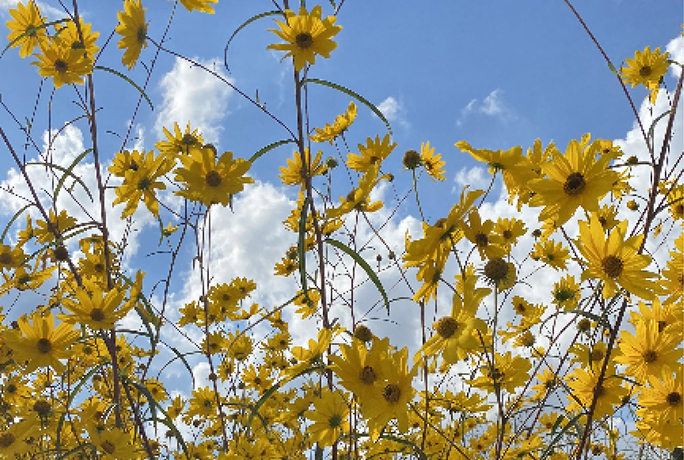


Rudbeckia maxima
Native to south-central USA in states such as Texas, Louisiana, and Arkansas, with a few records from South Carolina and North Carolina. A striking native perennial known for its towering flower stalks topped with 3 inch long golden-yellow petals that droop from a tall, dark central cone. Often reaching heights of…
Sassafras albidum
This is an easily identified small to occasionally medium deciduous tree, growing at times to 50 feet high, but usually smaller. It can be found in old fields, fencerows, mesic to upland woods, and forests of many types. It is somewhat of a pioneer woody species, frequently growing in dense stands…
Solidago flexicaulis
Notable for its brilliant yellow flowers. A woodland goldenrod with finely-serrated oval leaves and spikes of golden flowers. The stem can zig-zag, hence the common name, but can also be nearly straight. It is a great plant for adding color to the late-season shade garden. Spreads easily to form an attractive…
Scrophularia marilandica
Present in nearly all of the Mountain region and most of the Piedmont of North Carolina, Late Figwort is a pollinator magnet! An upright, square-stemmed perennial native to open woods and roadsides, its tiny, greenish purple two-lipped, tubular flowers with reddish-brown interiors bloom in summer, following Early Figwort (Scrophularia lanceolata). This…
Scrophularia lanceolata
Puzzlingly very rare in North Carolina, certainly under-observed or mistaken for the more common species Scrophularia marilandica. Found in only a handful of counties, this upright perennial frequents upland hardwood forests with slightly acidic soils. Not known for their beauty—blooms could be called subtle—but they are abundant in nectar! This makes…
Rhexia virginica
In its natural setting, Meadow Beauty can be found growing in wetlands, wet meadows, and open sandy locations. It stands between 1 to 1.5 feet tall. The taller plants sprawl along the ground while shorter ones stand erect. Growing from an underground tuber, it is known to spread rapidly which makes…
Morus rubra
The only native mulberry naturally occurring in North Carolina! A medium sized deciduous tree with a dense, spreading crown and dark green leaves that are loosely heart-shaped. Typically found in part shade, floodplain forest, rocky slopes and woodland edges where it averages 45-50 feet. The tree is most often dioecious (male…
Verbena stricta
Although sparsely found in North Carolina, Hoary Vervain can be found in prairies, meadows, and open woodlands. In summer, flowers bloom a few at a time, Hoary Vervain’s showy purple flowers bloom starting at the bottom of narrow pencil-like panicles moving up throughout the blooming season. Blooms attract a variety of…
Solidago bicolor
While other goldenrod species bloom yellow, White Goldenrod is the only one native to the east coast that blooms white. Yellow and white ray flowers bloom late summer to fall on spikes, and it looks beautiful planted alongside asters. It is naturally found in dry upland forests, rocky woodlands, and roadsides.…
Pycnanthemum flexuosum
Appalachian Mountain Mint is a spreading perennial with high pollinator value. Preferring rich loamy soil, it does well when soil is moist with good drainage and will spread readily when enough moisture and sunlight is provided. Like other members of the mint family, stems are square shaped and aromatic. The leaves…
Hypericum prolificum
Bright yellow flowers with showy stamens bloom throughout summer into early fall on the current year’s growth. Shrubby St. John’s Wort is a deciduous to evergreen shrub with a compact and dense habit. Its dark green leaves grow oppositely or in whorls along multi-stemmed branches. In nature it is found in…
Hydrangea arborescens
Smooth Hydrangea is the most common hydrangea found in North Carolina. This shrub has a suckering, spreading form with an open crown. Leaves are egg-shaped and have smooth undersides, giving this plant its common name. The flowers are in dome shaped corymbs, with tiny fertile flowers throughout and open infertile flowers…
Euthamia graminifolia
Grass-leaved Goldenrod is a quick-growing, dense clumping perennial in the Aster family. Slender, grass-like leaves grow alternately up the length of the stems, giving this plant its common name. From July to October, rounded flat-topped clusters of golden yellow flowers make their appearance, giving way to cypselae in colder months. Nectar…
Cirsium discolor
Field Thistle has incredible value to wildlife as a food source. Native bees, beetles, butterflies, moths, and hummingbirds flock to the blooms of this plant for its sweet nectar. Songbirds eat the seeds, while Goldfinches are particularly fond of them. Not to be confused with aggressive non-native bull thistle, which blooms…
Chelone obliqua
Although rare in North Carolina, Pink Turtlehead can be found in moist woods, swampy areas, floodplains, alluvial forests, and stream margins. Pink to red flowers mimicking the heads of open-mouthed turtles make a display in late summer to fall. If you look closely, each flower has a pale-yellow beard in the…
Baptisia bracteata
Cream flowers form clusters or bracts on long panicles over compound elliptical leaves. Cream Wild Indigo is a compact, mounding legume with incredible wildlife value. Flowers in the Baptisia genus are unique in shape and while accessing nectar may be arduous to some insects, our native bumblebees gladly rise to the…